
To organize B-roll footage for reuse, keep the original shoot context and give yourself a visual way to search across projects. The goal is to find B-roll you already filmed when a new edit needs it, even if you cannot remember the filename or the project it came from.
A shot of water, a street crossing, or someone making coffee may be useful long after its first edit. Leaving it inside a project folder is sensible source management. Forgetting that it exists is the retrieval problem.
Keep the shoot context, then browse across it
Avoid pulling reusable clips out of their original folders just to create a “best B-roll” folder. That can separate media from useful context and create another copy you have to maintain. Instead, keep a reliable source location and catalog the folders you want to search together.
Source context helps when visual memory is vague. A project name, location, camera folder, or approximate date can reduce a large library to a manageable group. Preserve those details when they are useful, and keep backup decisions separate from cataloging.
For footage that currently has no system at all, start with the video file organization guide. You can make the archive retrievable before attempting a complete naming cleanup.
Organize B-roll footage for the next edit
Think about how a future editor will ask for a shot. It might be a subject: “a cat.” It might be an action: “stirring coffee.” It might be a property: a vertical clip short enough to use as a cutaway.
Your footage library should support those different ways of remembering. Filenames and paths preserve shoot context. Metadata helps with technical constraints. Visual browsing helps you recognize a shot without having labelled every subject in advance.
Start with a useful portion of the library, such as one recent shoot and one older drive. Prepare it, retrieve a few remembered clips, and see which details help. A system you can repeat is more valuable than an elaborate taxonomy you abandon after a week.
Look beyond the cover image
Many B-roll clips contain more than their opening frame suggests. A pan reveals another building. A person enters the shot. A camera move ends on the detail that makes the clip useful.
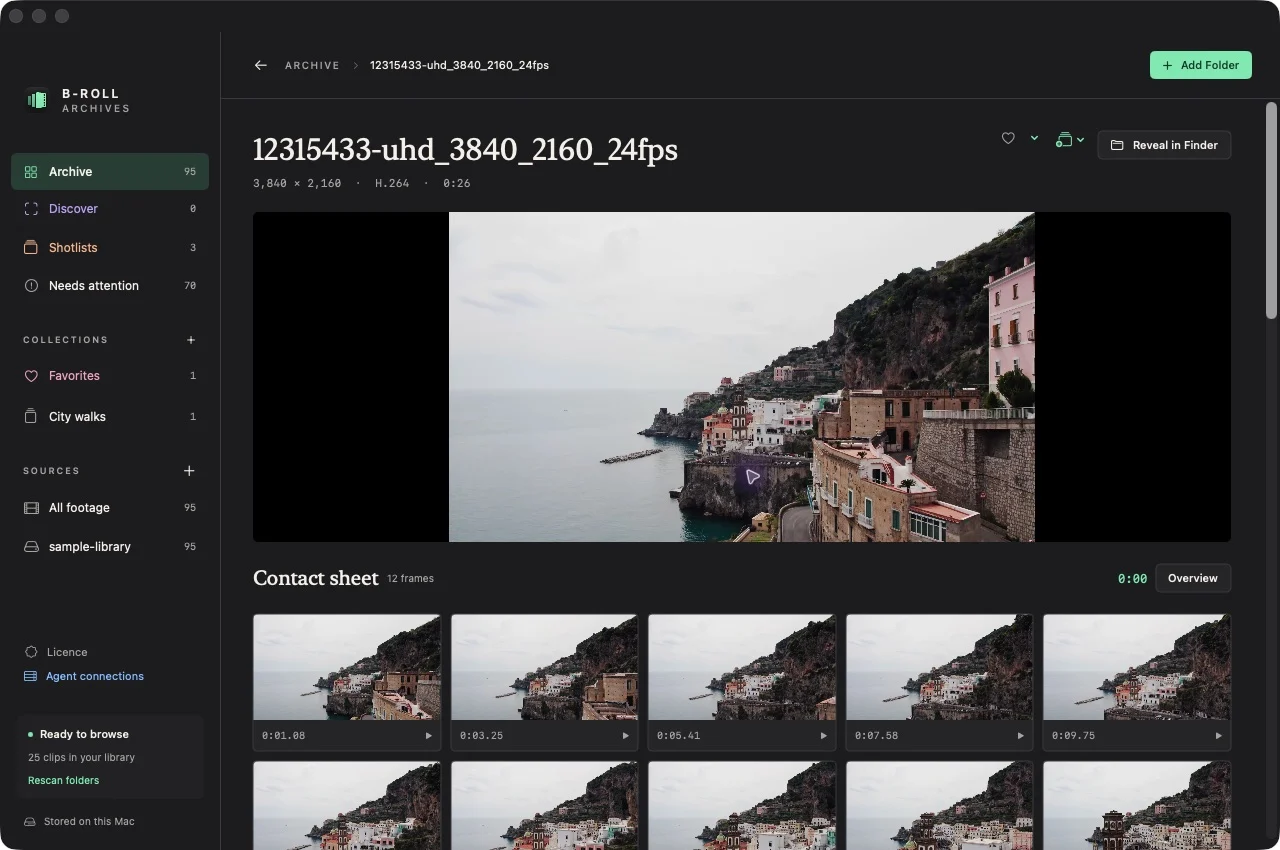
A video contact sheet exposes sampled moments across the clip. In the example above, the coastal shot changes composition as the camera moves; several views belong to the same source video. You can scan those samples before deciding whether to open the file.
B-Roll Archives creates twelve overview frames per readable clip. Selecting one opens playback at its recorded timestamp. Those frames are a guide to the contents, rather than a guarantee that every useful event is represented. Read the contact-sheet browsing guide if you need to distinguish sampled browsing from static export.
Search with what you remember
Use metadata search when you remember part of the filename, folder, or embedded detail. Narrow with duration, orientation, codec, resolution, source, or date when those constraints are meaningful.
Use visual search when you remember what the shot looks like. The prototype compares the description with locally indexed overview frames. Its results are ranked matches, so inspect the frame and play the clip before treating a result as the answer.
There are two practical limits. The visual index needs its own preparation pass, and brief moments between the twelve samples may be missed. A more specific description can help, but it cannot recover an event that was never sampled. Visual-search setup covers preparation and result interpretation.
Reuse starts with getting back to the source
Once you find a clip, confirm that it fits the edit and return to the original file. The app leaves originals where they are; it does not move footage into a new library or export an editing timeline.
If an external drive is disconnected, prepared previews and metadata can still remind you what you filmed. Reconnect that drive to play the original. A visible contact sheet is not evidence that the source file is currently available.
The habit to keep is simple: when a shoot is safely stored and backed up, add it to the searchable catalog. That gives its B-roll a chance to be useful again without asking you to remember every clip yourself.